UN warns global temperatures could rise by 2.8°C by 2100
Iraqi Ministry of Environment announces clearance of nearly 4 billion square meters of landmines
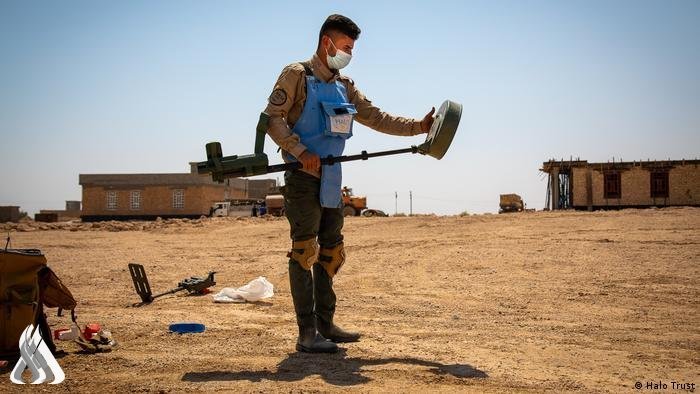
The General Directorate of Mine Action at the Ministry of Environment announced on Monday that nearly four billion square meters of land contaminated with landmines and explosive remnants of war have been cleared. The ministry also outlined its 2026 plans under the national strategy aimed at declaring Iraq mine-free by 2028.
Administrative Undersecretary of the Ministry of Environment and Director General of Mine Action, Iktifa Al-Hasnawi, stated that the total area identified as contaminated since the launch of the national program through mid-February stands at 6,767,134,856 square meters. Of that figure, 3,958,775,336 square meters have been fully cleared.
She noted that approximately 787,566,440 square meters are currently undergoing clearance under active work orders, while 2,367,571,954 square meters remain classified as hazardous and require future intervention. Basra Governorate, she emphasized, continues to be the most heavily contaminated area due to mines and remnants of past conflicts.
On risk reduction efforts, Al-Hasnawi told the Iraqi News Agency (INA) that 2,965,858,079 square meters have been released through technical survey and clearance operations. In addition, 28,451,474,612 square meters have been confirmed safe through non-technical surveys. Basra leads clearance operations, with more than 1.226 billion square meters cleared since the program began.
2026 Strategy and Key Priorities
Al-Hasnawi affirmed that the department is implementing the National Mine Action Strategy (2023–2028), which seeks to address contamination in line with international agreements and obligations.
She explained that the 2026 plan is built on several core priorities. These include intensifying technical surveys and issuing land-release certificates to identify and secure contaminated areas ahead of reconstruction projects. The strategy also focuses on strengthening institutional coordination between the Ministry of Environment, the Ministry of Planning, and relevant executive bodies to ensure adequate funding and logistical support.
International partnerships will continue to play a central role, with Iraq drawing on technical and technological assistance from global partners to enhance national capabilities. Efforts will also concentrate on capacity building by improving the performance of Iraqi demining teams and expanding public awareness campaigns to reduce accidents in affected communities.
In parallel, the ministry aims to strengthen support for victims by activating rescue mechanisms and promoting social reintegration programs for those impacted by explosive remnants of war.
Al-Hasnawi stressed that Iraq remains committed to fulfilling its obligations under the Ottawa Convention. She noted that demining efforts are being reinforced through coordinated national action involving the Ministries of Defense and Interior, the Popular Mobilization Forces, and international organizations.
She concluded that since assuming her position, she and her team of experts have worked to develop comprehensive scientific plans to address what she described as a national crisis—one that requires unified and sustained efforts to eliminate mine contamination permanently.
Latest News