Secretary-General of the Imam Hussain Holy Shrine: Forum of Holy Shrine Secretaries-General serves as a beacon for reform and community service
Tunisian Novelist Amina Zarig: “We returned from Karbala laden with hope and the fragrance of Al-Hussain (peace be upon him)”
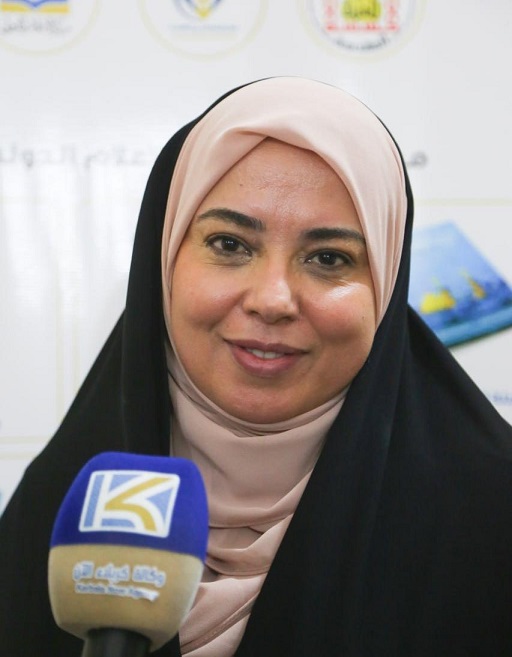
Interviewer: Emad Bao
Karbala Now: To begin, could you introduce yourself and tell us about your work?
I am Amina Zarig, a Tunisian novelist, publisher, and owner of Dar Al-Amina for Publishing and Distribution in the city of Kairouan. I was truly delighted to participate in this Iraqi-Tunisian cultural forum. It was both a new discovery and a great honor for me.
Karbala Now: What are your impressions of this first Iraqi-Tunisian cultural forum, and what has it added to your experience?
I believe forums like this open important avenues for dialogue and mutual understanding among Arab peoples. They allow intellectuals to engage directly with one another, away from stereotypes and preconceived notions. Personally, it was a deeply enriching experience on both the cultural and human levels, and it revealed to me the deep bonds that connect Iraq and Tunisia despite the geographical distance between them.
Karbala Now: How did you perceive the holy city of Karbala, and what does Imam Hussain (peace be upon him) represent to you?
In my view, Karbala lives within the conscience of every believer because of its profound spiritual symbolism. It represents an eternal sorrow in the hearts of free people and a land sanctified through sacrifice for all humanity.
Imam Hussain (peace be upon him) offered humanity a timeless lesson in dignity, steadfastness, and rejection of injustice—values we are in great need of today. Arriving in this sacred city filled us with a mixture of emotions: sorrow, spiritual closeness, and hope.
Karbala Now: Tunisia and Iraq both possess ancient civilizations stretching from Carthage to Babylon. How can this shared heritage help shape a modern Arab cultural discourse that transcends political borders?
Tunisia and Iraq are two deeply rooted civilizations whose cultural ties have never truly disappeared, although political circumstances may have weakened exchanges at times.
Organizing cultural forums and intellectual gatherings helps rebuild bridges of dialogue and cooperation. Most importantly, such initiatives unite hearts around the values of truth and shared humanity, especially during a time when the Arab world needs greater unity rather than division.
Karbala Now: To what extent do figures such as Imam Hussain contribute to shaping the collective consciousness of Tunisians?
The Tunisian people—especially ordinary citizens—hold deep love for Imam Ali and the Ahlulbayt, the family of the Prophet Muhammad (peace be upon them all). Through sincere reflection, one can hear the voice of Imam Hussain calling for resistance against injustice and support for truth.
Love for the Ahlulbayt naturally guides people toward Imam Hussain without the need for external persuasion.
Karbala Now: Could Karbala be viewed as a model of transnational identity? How does a Tunisian intellectual perceive the cultural diversity gathered in one place?
Cultural diversity opens broad horizons for understanding, growth, and acceptance of others. Human identity develops through interaction with different cultures and communities.
Humanity itself resembles a vast mosaic, where each culture and belief contributes to the larger picture. Beyond the religious aspect, the movement of Imam Hussain also represents a universal philosophy of resistance against oppression—an idea that continues to inspire contemporary literature and thought.
Karbala Now: Does literature lose its freedom when it aligns itself with human causes, or does art without a message lose its meaning?
I believe true literature must reflect humanity and its struggles. The martyrdom of Imam Hussain represents one of history’s greatest human and intellectual moments, capable of inspiring timeless literary and artistic works. In Karbala, the meanings of sacrifice, death, and redemption were expressed in their most profound form.
Karbala Now: How would you describe the spiritual and aesthetic atmosphere of the Holy Shrines? Did anything remind you of Kairouan?
I am a daughter of Kairouan and grew up near the Mosque of Uqba ibn Nafi. In Karbala, I felt that same sense of history and deep spirituality.
The atmosphere here captivates visitors with its spiritual energy. Although the architecture of Karbala differs from that of Kairouan, this diversity itself is beautiful and creates a unique sense of harmony.
Karbala Now: What are your impressions of the volunteer service system in Karbala?
Through our visits and meetings with officials at the Holy Shrines, we witnessed how serving humanity lies at the heart of this system. This is truly admirable.
The essence of the Prophetic message is to honor and serve human beings, and this spirit is clearly reflected in the dedication shown toward visitors regardless of their sect or religion.
Karbala Now: What major issues should Iraqi-Tunisian dialogue focus on today?
One of the most important topics discussed during the forum was the Muslim family. I believe this issue deserves serious attention.
Women form the foundation of the family, and Islamic history offers many inspiring female role models. Yet too often, people search elsewhere for examples. Following the events in Gaza, we are once again compelled to ask: who truly represents civilization and humanity today?
Karbala Now: What did you witness in Karbala’s streets and markets that books could never convey?
Iraqi hospitality is famous, but experiencing it personally is something entirely different.
Karbala continues to preserve noble human values even at a time when many values around the world seem to be fading and faith sometimes risks becoming empty ritual.
Karbala Now: What message will you take back to Tunisia about the “New Iraq”?
As a Tunisian writer, I believe the true impact of this journey will reveal itself once I return to my writing desk. And as a publisher, I believe books have the power to cross borders and connect people.
Knowledge is a powerful force when accompanied by sincere belief in just causes.
I return to Kairouan carrying within me the spirit of Karbala.