Calgary marks ‘Islamic History Month’ in October
Taq Kasra: The Monument, the Prayer Hall, and the Witness
By: Iftikhar Al-Saffar
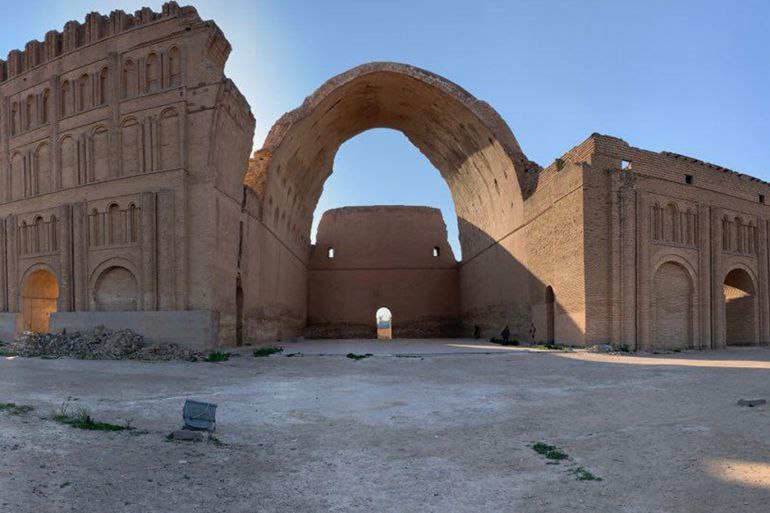
The majestic Taq Kasra (the Arch of Khosrow) stood for centuries untouched by axes and destruction. Yet, on the night of the birth of the Prophet Muhammad (peace be upon him and his family), a tremendous sound was heard as the arch cracked and fourteen of its balconies collapsed. On that same night, the sacred fires of Persia—kept burning for a thousand years—were extinguished. Following the Muslim conquest of Ctesiphon, the arch was converted into a prayer hall, and historical accounts affirm that Imam Ali (peace be upon him) performed prayers there. Today, Taq Kasra remains the most prominent remnant of one of the palaces of Khosrow Anushirvan, located south of Baghdad in the historic region of Ctesiphon, which is administratively part of Baghdad Governorate.
Its Location and History
Taq Kasra, also known as Iwan Khosrow or Iwan al-Mada'in, is an ancient architectural monument dating back to the Sasanian era. It lies approximately forty kilometers south of Baghdad, near the town of Salman Pak on the eastern bank of the Tigris River. The area is also home to the shrines of Salman al-Muhammadi and Hudhayfah ibn al-Yaman.
According to History of Ancient Iran (Vol. 4, p. 2931), the Iwan of Ctesiphon was constructed in 550 CE during the reign of Khosrow Anushirvan, a view also cited by Yaqut Al-Hamawi in Mu‘jam al-Buldan (Vol. 5, p. 74). Ibn Al-Jawzi, however, reports that Ctesiphon contained two iwans: one built by Shapur I ibn Ardashir (r. 240–271 CE), and another—known as the Iwan of Khosrow—constructed by Shapur II ibn Hormuz, known as Dhul-Aktaf, who died in 370 CE.
The structure was built of massive bricks bonded with plaster, measuring approximately one hundred cubits in length and fifty cubits in width, with an arch rising nearly thirty meters above the ground. Part of the monument was dismantled during the reign of the Abbasid Caliph al-Mansur in 146 AH (763 CE), as recorded by Al-Tabari (History of Nations and Kings, Vol. 7, p. 651), when he sought to reuse its materials for the construction of Baghdad. The project was later abandoned after the immense cost of demolition and transportation became evident.
In 1888, a flood caused further destruction to the structure. Partial reconstruction efforts were undertaken during the 1980s under the Iraqi government but were left incomplete, coming to a halt in 1991 during the Gulf War. At present, the University of Chicago, in cooperation with the Iraqi government, is engaged in restoration efforts as part of the “Diyala Project.”
Events Surrounding the Birth of the Prophet (peace and blessings be upon him)
On the night of the Prophet Muhammad’s birth (peace and blessings be upon him), a series of extraordinary events occurred—signs that coincided with the advent of his blessed mission. Among these were the shaking and cracking of the Iwan of Khosrow, the collapse of fourteen of its balconies, the extinguishing of the Persian fires that had burned continuously for a millennium, the drying up of Lake Sawa, and unsettling dreams witnessed by the Mobeds and the Sasanian king. These events are documented by Al-Bayhaqi in Dala’il Al-Nubuwwah (Vol. 1, p. 126).
The Mobeds were the chief judges and religious authorities of Zoroastrianism; a Mobed is comparable to a judge, as explained in Al-Nihayah fi Gharib Al-Hadith wa Al-Athar (Vol. 4, p. 369).
The Iwan as a Place of Prayer
Following the conquest of Ctesiphon, Sa‘d ibn Abi Waqqas converted the Iwan of Khosrow into a prayer hall. It is reported that Imam Ali (peace be upon him) prayed there, as mentioned by Al-Tabari in History of Nations and Kings (Vol. 7, p. 651). In recognition of its spiritual significance, Sheikh Abbas Qummi, in Mafatih Al-Jinan, recommended that visitors, after completing their ziyarat of Sheikh Salman Al-Muhammadi, perform two or more rak‘ahs of prayer at the Arch of Khosrow.