كربلاء المقدسة تفتتح 6 مدارس للأيتام مجاناً
The dome of the shrine of Imam Hussain (peace be upon him) in the memoirs of travelers and Orientalists
By: Ghassan Al-Aqabi
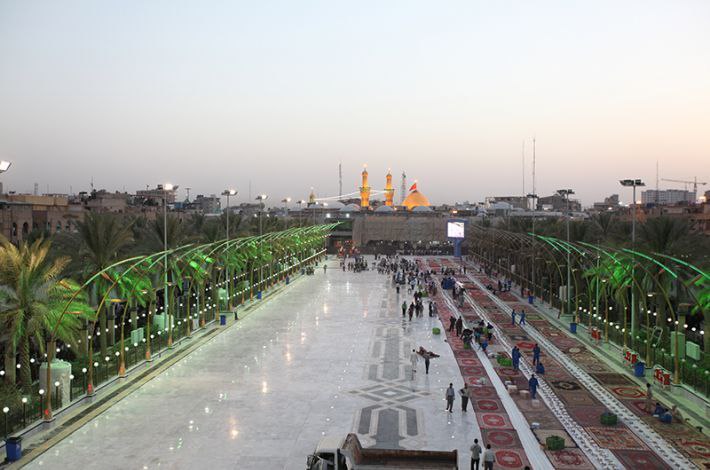
The revered dome of the Imam Hussain Holy Shrine has passed through numerous historical stages, documented by many travelers and Orientalists who visited Karbala over the centuries. One of the earliest accounts was recorded by the traveler Abu Talib Khan, who visited Karbala shortly after the Wahhabi attack. He wrote:
“The King of Persia, Muhammad Khan Qajar, renovated the courtyard of the Karbala shrine several years ago. The entire dome is covered with gold plates, and the interior of the shrine is adorned with intricate designs and gilding.”
Around 1267 AH, the German Orientalist Theodor Nöldeke visited Karbala and described the Imam Hussain Holy Shrine as follows:
“The shrine of the third Imam, Hussain ibn Ali (peace be upon them), is located within a courtyard measuring approximately 354 by 270 feet. It is surrounded by arcades and corners, and its walls are decorated with a continuous, glittering inlaid band said to contain Quranic inscriptions in blue and white tiles. The main building is accessed through an outer golden iwan, and the shrine itself is encircled by arched corridors allowing visitors to circumambulate the tomb. Above the shrine rises a towering semi-circular dome, at the base of which stands a silver sarcophagus weighing between 109 and 122 pounds.”
This account is cited in The Encyclopedia of Holy Shrines, Karbala section, p. 203, by Jaafar Al-Khayyat.
In 1270 AH, the English archaeologist and Orientalist William Kennett Loftus visited Karbala and noted:
“…the dome of Hussein (peace be upon him) alone is covered with gold in Karbala.”
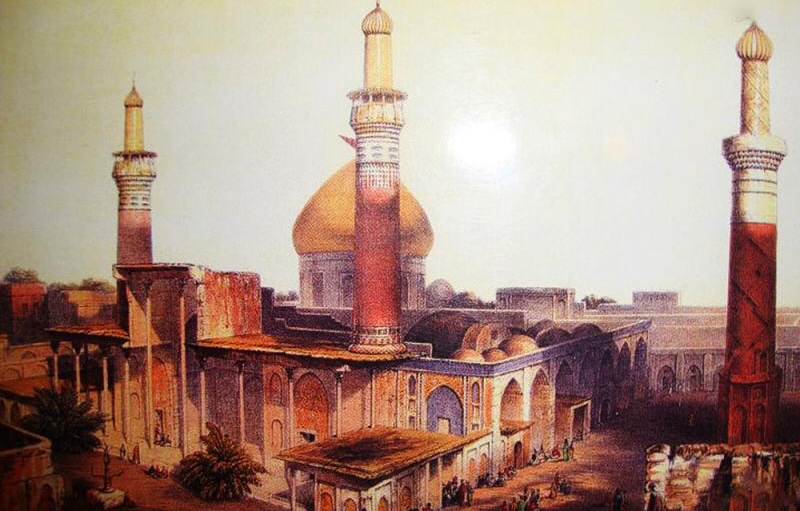
Of particular importance is the visit of the English painter Robert Clive in 1279 AH (1862 CE), who painted the shrine of Imam Hussain from close range at a time when photography was not yet available. His artwork appears to accurately depict the shrine, including the golden dome, viewed from the southeastern corner.
According to Dr. Sheikh Muhammad Sadiq Al-Karbasi, in his book The History of the Shrines (Vol. 2, p. 187), under the section “The Orientalists’ and Travelers’ View of the Holy Shrine of Hussein,” he writes:
“The neck of the dome is encircled by an enamel frieze, and its base contains a number of windows, as it does today. It appears that it originally had twelve openings, which may not have been windows but decorative arches covered with tiled ornamentation. Historical accounts indicate that actual openings were made in 1297 AH. When this information is compared with contemporary paintings, it becomes clear that these openings were part of the wall structure rather than columns.”
Jaafar Al-Khalili notes in The Encyclopedia of Holy Shrines, Karbala section (p. 296), that in 1281 AH (1864 CE), the traveler John Usher visited Iraq and described the shrine, stating:
“The mosque has a gilded dome alongside three minarets from which the call to prayer is raised.”
In 1299 AH (1881 CE), the French traveler and writer Madame Jeanne Dieulafoy visited Karbala. From the rooftop of a nearby house, she observed the golden dome of the holy shrine from a distance.
In early 1316 AH (1898 CE), the German consul Friedrich Rosen visited Karbala and described the city and its holy landmarks. He wrote:
“We were not allowed to enter the shrines of Hussein and Abbas. The latter stands within a spacious mosque adorned with blue tiles, while the former is of similar design but more beautiful. It is crowned by a copper dome plated with gold. When we viewed it the following day from the roof of a neighboring building, we had to wear dark glasses to protect our eyes from the glare of the gilded dome.”
Among English travelers, Gertrude Bell described the revered dome following her visit to Karbala in 1327 AH (1909 CE), writing:
“This shrine is a destination no less sacred than Mecca. Yet it was not merely the golden dome of the shrine of Hussein (peace be upon him) that stirred the imagination, although the dome shelters the most precious treasury of offerings that any shrine possesses.”
Accounts by Orientalists continued into the twentieth century. Mrs. Stephens, who visited Karbala in 1336 AH (1918 CE), recorded her observations in the book On the Banks of the Tigris and Euphrates, published in London in 1923. She wrote:
“If Najaf represents the head of Shia thought, then Karbala is its heart. Karbala is even more significant, for Shiite devotion and passion emanate from it in the name of Hussein (peace be upon him), who is buried beneath a golden dome in what is known as the Great Sanctuary—one of the most important and sacred sites for Shias.”
In 1346 AH (1927 CE), the English researcher Dr. Peter Clark described the shrine succinctly, noting:
“The tomb of Hussein (peace be upon him) in Karbala, with its three minarets and its gilded dome.”
Among Arab travelers, Dr. Sheikh Al-Karbasi mentions the Egyptian writer Muhammad Thabit, who visited Iraq in 1350 AH (1931 CE). He wrote:
“Imam Hussein (peace be upon him) rests beneath a golden dome known as the Great Sanctuary, which is visited by vast numbers of people, particularly during the month of Muharram.”
The Dutch writer Honeyman, who visited Karbala prior to 1354 AH (1935 CE), provided a vivid description of the shrine’s interior, as quoted in the Islamic Encyclopedia:
“The impression one receives inside the shrine is unparalleled, resembling something drawn from legend. Whether at twilight or during the day, the interior remains softly lit. Light from countless lamps and candles surrounding the silver lattice is reflected thousands of times by innumerable crystal surfaces, creating a magical effect beyond imagination. The light gradually fades toward the ceiling of the dome, where only a few sparkling crystals remain, scattered like stars in the sky.”
المرفقات
آخر ما تم نشره